
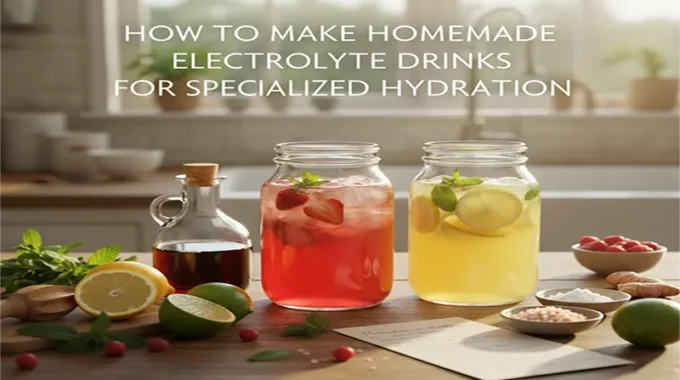
How to Make Homemade Electrolyte Drinks for Specialized Hydration

In the world of fitness and wellness, “hydration” is often treated as a synonym for “drinking more water.” However, water is only one half of the equation. To truly hydrate at a cellular level, your body requires Electrolytes—essential minerals that carry an electric charge. These minerals, including Sodium, Potassium, Magnesium, and Calcium, are responsible for nerve signaling, muscle contraction, and maintaining the delicate fluid balance inside and outside your cells.
While neon-colored commercial sports drinks have dominated the market for decades, they often come with a heavy baggage of artificial dyes, high-fructose corn syrup, and synthetic preservatives. By making your own electrolyte drinks, you can control the Bioavailability of the minerals and tailor the Osmolality (the concentration of particles in the fluid) to your specific physical needs.
The Anatomy of an Electrolyte: Why Salt and Sugar Matter
To understand specialized hydration, we must understand the Sodium-Glucose Co-Transporter. In the lining of the small intestine, there is a “protein pump” that moves nutrients into the bloodstream. This pump is specifically designed to transport one molecule of glucose along with two molecules of sodium.
When you add a precise, small amount of sugar (glucose) to a salt-water solution, it acts as a “carrier,” pulling water and minerals into your system much faster than plain water ever could. This is the difference between an Isotonic drink (which matches the concentration of your blood) and a Hypotonic drink (which is more dilute for faster absorption).
The Three Specialized Electrolyte Formulas
Not all hydration needs are equal. A marathon runner in 90°C heat requires a different mineral profile than someone recovering from a stomach flu or a professional sitting at a desk.
1. The Endurance Athlete (High Intensity)
When you sweat heavily for over 60 minutes, you aren’t just losing water; you are …